

Making sense of conservable days
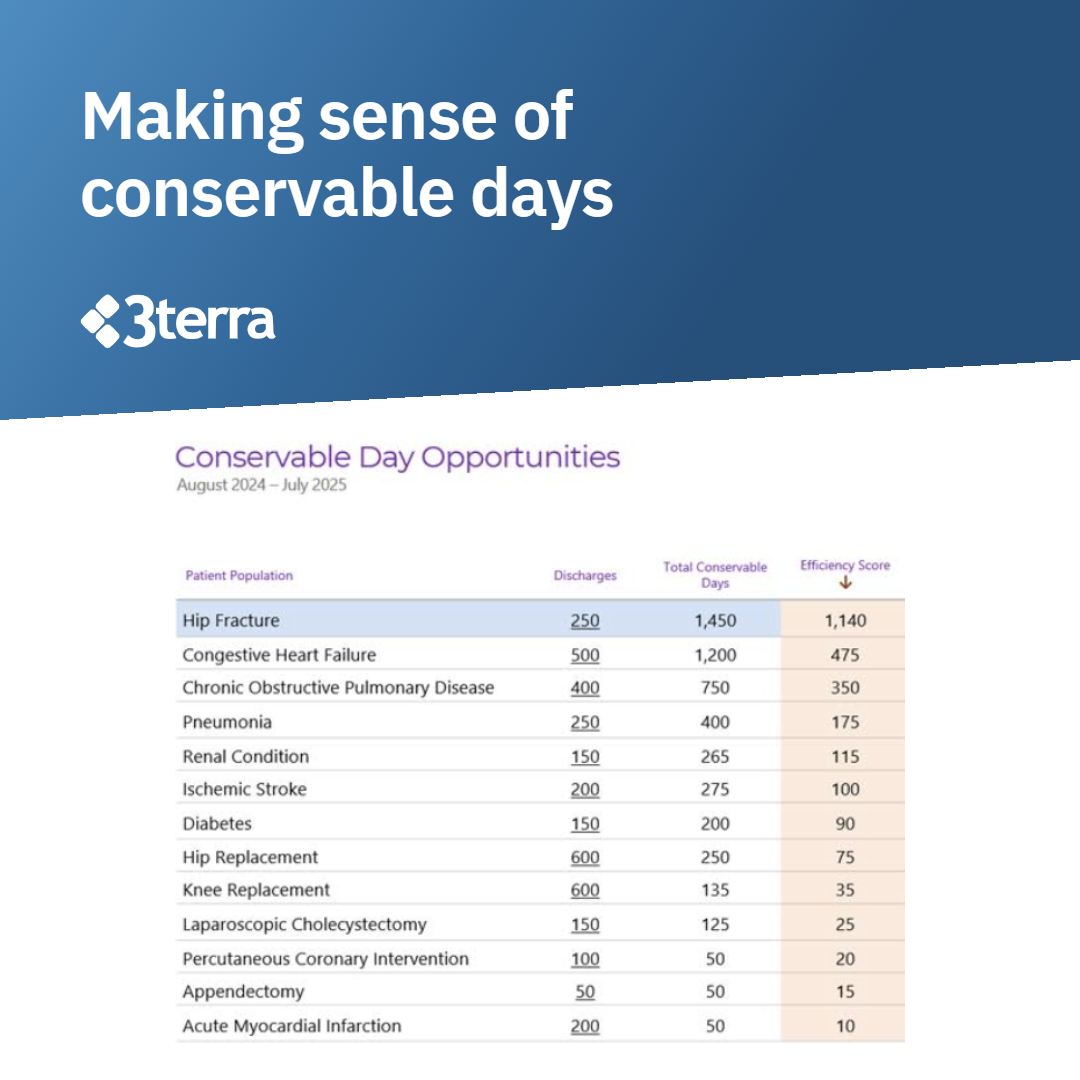
1. Introduction 2. What are conservable days? 3. Why are conservable days important? 4. What are the main reasons for conservable day challenges? 5. Where can data analysis help? 6. Conclusion Introduction Conservable days represent one of hospital management’s most challenging metrics: everyone watches them, few understand them, and many struggle to improve them despite significant effort. Poor performance could indicate operational inefficiency, complex patient populations, data quality issues, or methodological mismatch, and usually some combination of all four. What are conservable days? Every inpatient visit is “coded” with standardized diagnoses and procedure codes. From these codes, an Expected Length …
How to work with physicians to improve data quality and funding
Physicians learn many things during their years of training. Unfortunately for the people who work in hospital Health Records and Decision Support departments, clinical documentation is generally not one of them. HIGH QUALITY PHYSICIAN DOCUMENTATION MATTERS MORE THAN EVER Since the launch of Health System Funding Reform (HSFR) in 2012, up to 70% of a hospital’s annual funding is based on their performance relative to other hospitals in Ontario. Efficiency is measured in terms of cost per weighted case, with the denominator directly coming from the output of Health Information Management (HIM) professionals coding and abstracting from physician documentation of discharged …
The revenue impact of unrecorded emergency department procedures
A central area of expertise at 3terra is helping hospitals improve data quality which can lead to improved funding, as outlined in this article. This year, we expanded our focus and started to analyze the effect of poor data quality on outpatient cases, including Emergency Department (ED) visits. This article provides an overview of those findings. THE METHODOLOGY The case weight (a measure of patient complexity that is used to determine hospital funding) for an ED visit is straightforward compared to inpatient stays. Generally speaking, patients are in the ED for a limited amount of time, so fewer interventions and procedures …
How data quality affects funding for Ontario hospitals
In 2012, the Ontario government introduced Health System Funding Reform (HSFR) which moved hospitals from global budgets to a form of activity-based funding. Up to 70% of hospital funding in Ontario will eventually be from activity-based allocations. In order for this funding model to work, the Ministry of Health and Long Term Care (MOHLTC) needs an accurate clinical representation of all patients treated by hospitals in the province. They get this information through the submission of patient encounter data files (patient abstracts) by each hospital. After a patient is discharged, coders in health records departments create an abstract designed to tell the story …

Recent Comments