

A guide to successful CDI software initiatives for Ontario hospitals
A comprehensive guide covering six high-level areas for successful Clinical Documentation Improvement (CDI) software initiatives in Ontario hospitals, drawn from working with over 40 hospitals.

November 29, 2019
X min read
A guide to successful CDI software initiatives for Ontario hospitals
Over the past decade, Clinical Documentation Improvement (CDI) has become increasingly important as Ontario has moved into data-driven funding mechanisms. With the new focus on financially incentivizing performance across the health system, data quality will continue to be a critical factor as it has been in similar models in other countries.
We've had the opportunity to work with over 40 hospitals in Ontario to help improve their clinical documentation through the implementation of our Data Quality Assist (DQA) CDI platform. We've published this with the hope that it provides insight into common areas that should be considered by Ontario hospitals to help ensure CDI success.
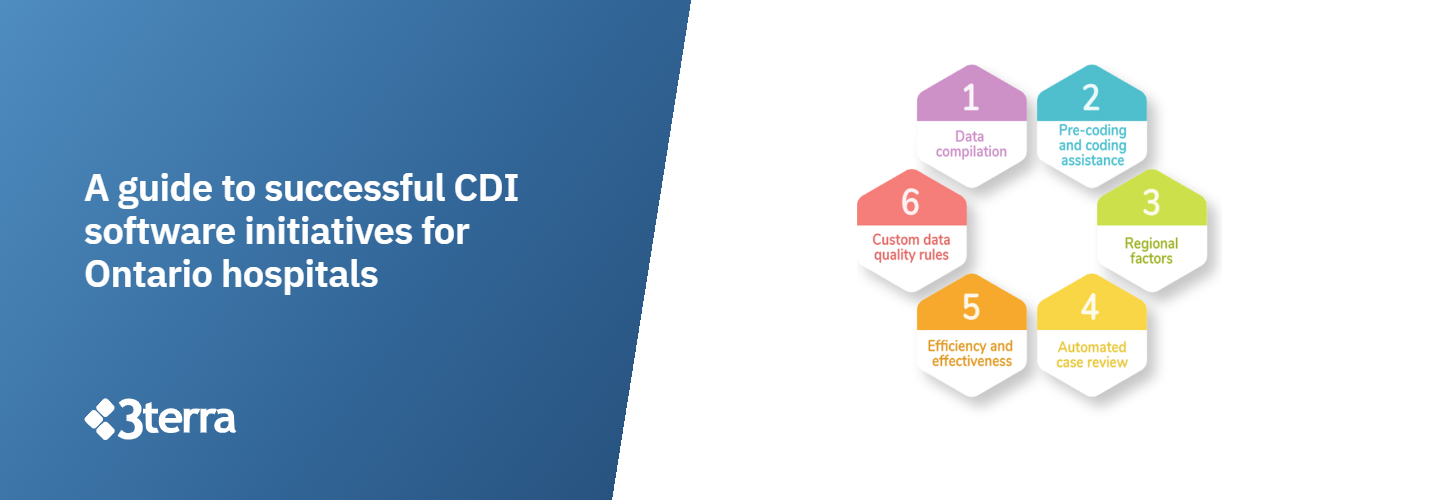
There are six high-level areas of focus that we will cover:
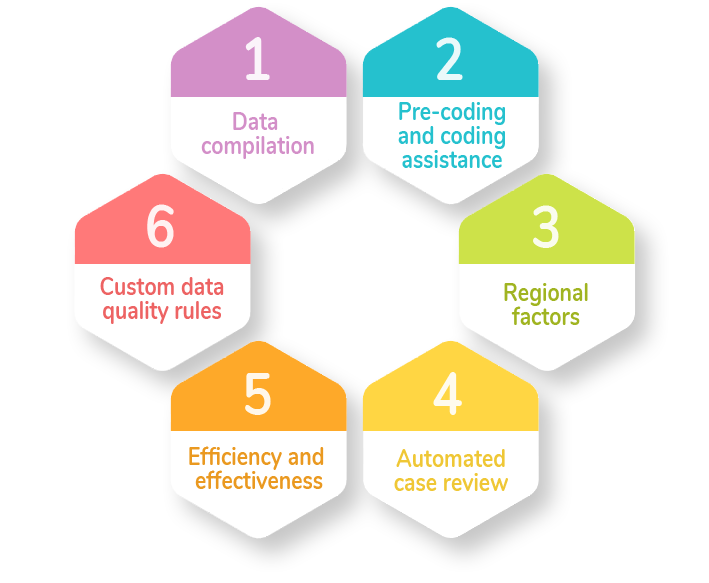
Data compilation
The operational challenges of CDI can be broken down into two main categories: comprehensive collection and compilation of data, and accurate interpretation of data. Without a data compilation strategy, it is simply not possible for clinical coders and automated systems to be fully effective.
Any robust CDI solution needs to include a frictionless way of introducing new data into the process without requiring substantial technical integration effort or customization from vendors. One thing became clear during the design of DQA: hospitals need to be able to easily bring in their own data without external vendor assistance. The inclusion of well-designed data interfaces is crucial, otherwise a CDI solution will stagnate.
Accurate interpretation of data
Ideally, all data pertaining to a patient encounter would be compiled, interpreted, and pre-coded automatically. These important sub-groups of encounter data need to be considered:
Interventions (CCI)
CMI and volume funding criteria are based on properly documented interventions. While larger procedures that drive case mix grouping are unlikely to be overlooked, other interventions such as vascular access devices and feeding tubes can be missed.
Diagnoses (ICD-10)
Proper diagnosis attribution is important as it affects CMI and other key calculations. There are many systems that employ a variety of Natural Language Processing (NLP) techniques to parse data and recommend ICD-10 codes, which reduces initial coding effort.
Key methodology factors
Certain data points (e.g., post-discharge home care, birth weight, patient services) have specific implications in Ontario. A physical stay in the ICU affects case weight and is therefore a critical factor in documentation.
Regional standards and policies
While identifying the existence of the factors listed above is important, it is also critical to account for factors pertaining to Canadian coding standards and provincial policies that affect hospital funding and accountability agreements.

Automated case review
Despite best efforts, mistakes can be made during the documentation and coding process. Automated case auditing has been a staple of the DQA CDI platform since its first version. With the help of many hospitals over several years, we've designed case profiling logic that uses a variety of statistics and Ontario/Canadian methodology calculations to determine whether a coded abstract is abnormal.
Process efficiency and analytics
Supplementary functionality to support the case review process is critical to minimize the input costs of CDI. Examples within DQA include root cause analysis through analytical reporting, collaboration tools including centralized case notes and workflow assignment, and effectiveness monitoring and rule tuning to reduce false positives.
Extensible data quality rules
Flexibility in creating new data quality rules has been a key driver of DQA's success. The flexible rule engine allowed us to integrate new intelligence rapidly based on techniques and approaches proven by Health Records departments across many hospitals.

Hints and pitfalls to avoid
- Be targeted in your efforts. Targeted CDI initiatives that address critical factors will always provide more benefit than generic approaches to data quality.
- Approach adapted solutions from the U.S. or other countries with caution. International vendors often don't adapt their software to address regional issues in smaller markets.
- Do background checks on vendor effectiveness before accepting astounding claims of massive CMI jumps.
- Using machine learning algorithms to automatically identify factors can streamline coding, but overreliance diminishes scrutiny by qualified coders.
- Be wary of claims that retrospective review can be made obsolete.
- Don't ignore integration challenges. Robust CDI processes need as much data as possible.
- If you're undergoing an EHR migration, CDI is even more important.
- Beware of long, expensive implementation processes. A good CDI vendor should be able to demonstrate value within a week.

Summary
Comprehensive CDI is nuanced and there are no silver bullets. Without taking a holistic view of the problem, hospitals run the risk of undertaking a large project for something that solves only one small portion of the actual problem.