

Introducing AI for clinical text interpretation in the 3terra platform
3terra has integrated Microsoft's Cognitive Services NLP into its platform, enabling world-class medical AI for all clients. This brings immediate implications for medical coding, hospital data analytics, and research practices.

August 16, 2021
X min read
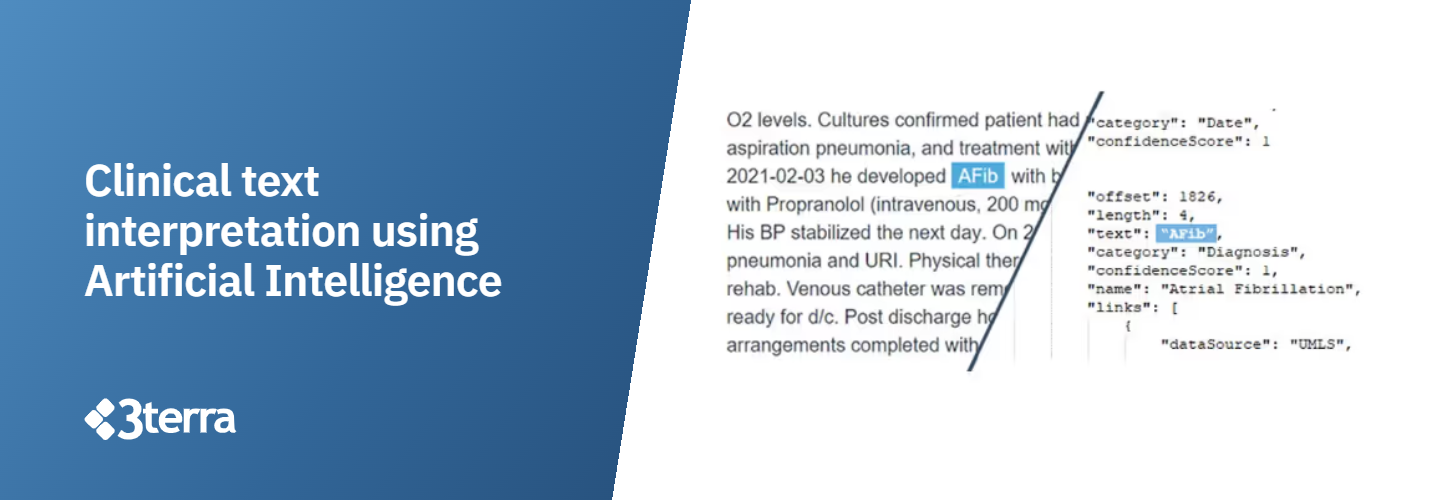
Introducing AI for clinical text interpretation in the 3terra platform
(For a brief overview of clinical text AI and how it will change hospital analytics, please first watch our introductory video.)
Over the past three years, the advancement of natural language processing (NLP) within healthcare has been remarkable to watch. In that time, a new service model has emerged where the top technology giants (Microsoft, Amazon, IBM, and Google) have released world class medical NLP Application Programming Interfaces (APIs) that enable new opportunities to use unstructured medical text to solve a wide variety of analytical and research problems.
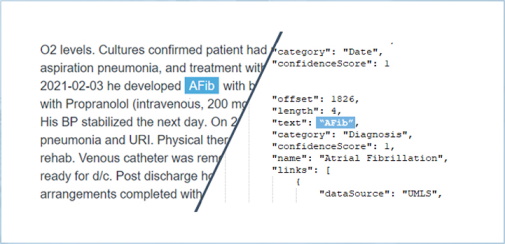
We recently completed the integration of Microsoft's Cognitive Services into our platform to assist in the translation of clinical text to identify medical concepts, entities, relationships, and syntactic context. This brings world-class medical AI to all of our clients with significant and immediate implications to their medical coding, research, and hospital data analytics practices.
NLP for medical text has been a topic of substantial research over the past decade. While there are many straightforward approaches to implementing NLP natively within our own engine, it would not be feasible to match the features, accuracy, and flexibility of what the formidable data science divisions at Microsoft, Google, IBM, and Amazon provide.
Microsoft has invested billions of dollars in their Azure Cognitive Services platform and they now provide a cloud infrastructure that is transforming healthcare. Coupled with the AI and analytics that 3terra has developed over the past 6 years to address Canadian-specific issues, our hospital clients now have access to a suite of tools that was simply unimaginable a short time ago.
How this affects our platform
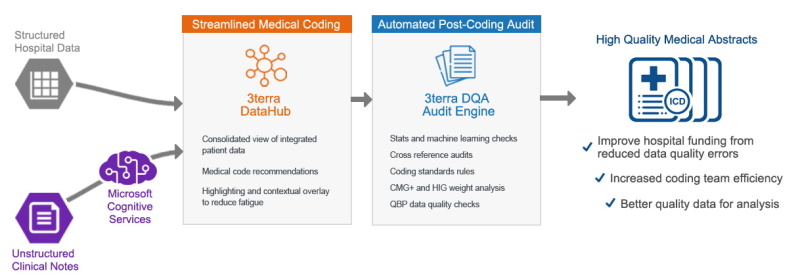
The initial use of this functionality for most of our clients will be to supplement our 3terra EMR Integration and DQA platforms as NLP is a natural fit within those tools. The introduction of NLP affects our current platform in two ways:
3terra EMR Integration
In addition to all of the current functionality, EMR Integration allows users to view clinical notes pertaining to any patient encounter along with all clinical concept labels, relationships, and pertinent contextual modifiers. Like other coding assistance tools, we employ selective highlighting and contextual popups to assist with choosing the proper medical codes. There are also workflow tools such as annotations, bookmarks, and search.
Data Quality Assist
High probability data quality errors detected from the clinical notes have been included into the auditing engine, similar to any other cross-reference data source. Like our other data quality engine rules, there are several options to tune the engine to reduce both false positives and false negatives.
Unlike other medical NLP platforms that have emerged over the past decade, there is no need to train the AI to get immediate value from the system. The performance of the Natural Language Processing engine without any data preprocessing or adaptive training is astonishing.
Limitless possibilities
Utilizing NLP for medical coding support is just the beginning of how this technology will benefit our Canadian clients. Taking unstructured clinical notes and decomposing them into semi-structured labeled medical concepts and relationships has many practical uses.
By storing and indexing these processed medical records, hospitals can now extract and utilize this data for a wide variety of analytical, statistical, and machine learning applications to drive quality improvement initiatives. The NLP engine handles semantic complexities such as conditional terms and negation. For instance, "patient refused intubation" will correctly detect that intubation was not performed.
The healthcare AI landscape has reached a significant milestone. Clinical text interpretation has effectively been refined and commercialized as a SaaS offering and there is much more to come. Our commitment, as always, is to adapt the leading data analytics tools, technological services, and best practices to serve the specific needs of Canadian hospitals.
A brief update on 3terra
We've been making significant investments in our platform to maximize the opportunities that recently released technology enables for healthcare. Since early 2020, we've rearchitected a large portion of our platform in preparation for new analytical capabilities enabled by Microsoft Power BI along with the integration of an NLP engine.
Over the past 6 months, we have piloted portions of our new Focused Insights service within several hospitals. The feedback has been enormously positive and we are currently rolling out initial modules as they have immediate applicability.